
Who do you think should be more grateful after a successful trip? The driver or the passenger? What comes to mind when you hear the word “empathy”. We will get back to answering the question in a bit.
Empathy is derived from the Greek word empatheia, which means “passion or state of emotion”. Empathy is simply being aware and recognising feelings, thoughts and processes of other people. It is the ability to understand and share another person’s emotions, it is essential to building good relationships both at work and in your personal life. People who do not exhibit empathy are viewed as cold and self-absorbed and often live isolated lives. It is going beyond yourself. Empathy has far reaching implications in many areas of our lives, business, work and innovations.
Empathy is not a decision set in stone, a person who lacks empathy can work on improving it by building Emotional intelligence. As with any other skill, it has to be a personal decision which an individual intentionally builds up and hopefully, in due time, identifies the changes he/she wishes to make.
What makes people lack Empathy?
- Genetics: Characteristics inherited from parents have been identified as a major reason why people lack empathy. This does not translate to an inability to change; however, it goes to show that a lot of effort has to be involved in improving your ability to empathise.
- Environment: Where you grew up, especially in early childhood, has a tendency to affect your behaviour. This is because children are more impressionable than adults and tend to stick to coping mechanisms learnt from childhood, no matter how destructive.
- Disease: Some psychological disorders that are related to a lack of empathy include: Psychopathy, Borderline personality disorder, and Narcissistic personality disorder. They can be seen as cold people since they seek to only improve their own well-being, they will be in need of specialised care.
- Trauma: A lack of empathy can stem from trauma related to an event like a Traumatic brain injury. These people are seen as egocentric, self-centred and insensitive to the needs of others. They will also need care
- Be intentional: We have to be the change that we wish to see in the world. You will need to challenge yourself if what you truly want is to change and this will involve moving out of your comfort zone, making a plan and sticking to it. Ask yourself the difficult questions, ask for feedback from friends and family members on your current behaviour and ways to actually improve.
- Be present: You need to be grounded and present in the moment and take note of mood swings and body language. In this social media age, we are all very distracted with our phones and do not seek to understand our environments before being understood. In every situation, be present, do not seek out distractions.
- Be a good listener: Listening is not listening to reply, but listening to understand. Listen to hear what is being said, taking notes on how you can improve the situations for both parties and achieve a win-win situation.
- Identify biases: We all have some hidden biases that interfere with our ability to listen and empathise. It may be centred on religion, ethnicity, race, gender, political affiliation, you name it. Do you have any biases listed? You need to learn to respect people’s opinions and attack the issue, not the person. Actively letting go of biases and stereotypes will enable you become more empathetic.
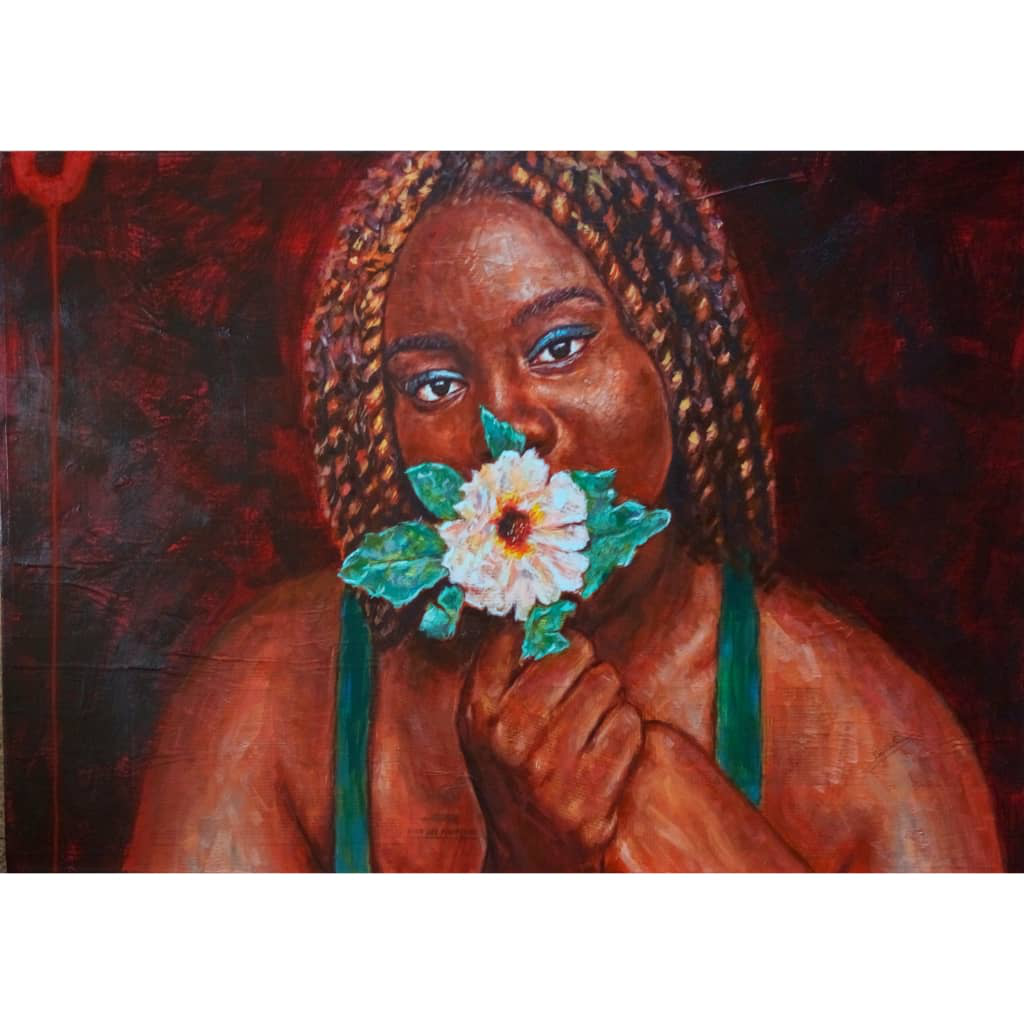
Be curious: You need to be open to learning from everyone. When you ask questions, you develop a stronger understanding of people around you and this can accelerate your change.
Art by Ogunlesi Paul, an Artist and Arts in Medicine Fellowship Alumnus
Benefits of Empathy
- Improved well-being: Empathy works both ways, caring for another person also does you a favour. In a situation of a quarrel, empathy serves to reduce stress and help solve problems and reduce quarrels.
- Better relationships: A person who is empathetic tends to come off as kind and compassionate and this can help them to have better relationships at work and at home.
- Better work performance: You will perform better because you will understand people better and be seen as understanding. This will in turn improve your work performance since you have better relationships and peace of mind.
Applications of Empathy
Design thinking: This is a methodology that seeks to provide a solution-based approach to solving problems. It is useful in tackling problems by understanding human needs, reframing the problem, and creating many ideas in brainstorming sessions. One of the core stages of design thinking is Empathy. Having an empathic understanding of the problem you are trying to solve is a crucial step in the design thinking process as it pertains to solving human problems.
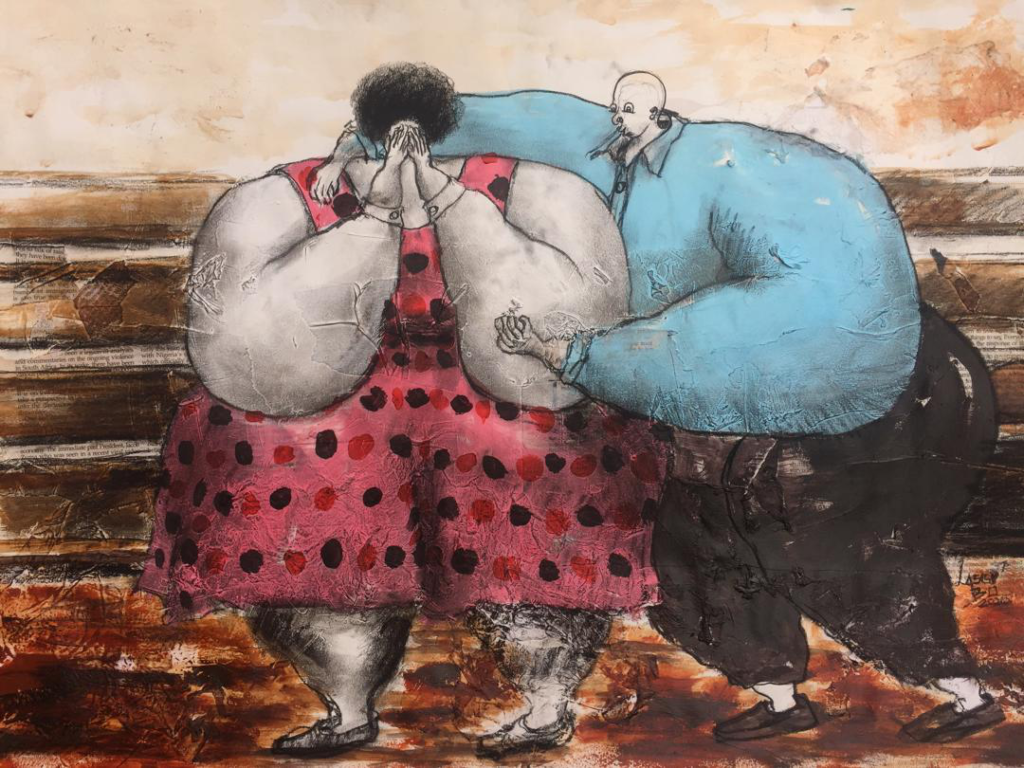
Art by Babatunde Lasisi an Artsist and Arts in Medicine Fellowship Alumnus.
Given the picture above, we can see that there are many words that come to mind when we think about empathy. Words like compassion, connection, kindness, support, assistance are some of the key words that are synonymous with empathy.
So, who should be more grateful at the end of a trip, the driver or the passenger? I think that both should be grateful. The driver for having someone who is willing to pay for his skills and the passenger for having someone who improves his life by the availability of his skills. This is because if there are no skilled personnel, money is only paper and if there are skilled personnel but no money, there can be no meaningful value exchange.
Art has many and sometimes contrary purposes, but one value that viewing and thinking about art does is to foster empathy by providing an avenue through a medium-writing, painting, music, dance- through which we feel or understand the experience of others from their perspective and this adds to the colourful experiences of our own lives.
References
About the Authors
Chibuike Alagboso a.k.a. Alas was born on the 4th of April 1986. He hails from Imo state, Nigeria. He is a Health Journalist and an Arts in Medicine Alumnus of the 2018 cohort.
His interests include Photography, Global Health, Social Entrepreneurship and Technology.
His hobbies are Chess, Gaming, Reading, Hiking and Ajala travels.
His strengths are Listening, Writing, Teaching.
His main weakness is Procrastination.
He inspires young people to action using media at the Nigeria Health Watch, health communication and advocacy organisation based in Abuja. He researches and writes stories about solutions to various health challenges in Nigeria. He is a 2017 Mandela Washington Fellow and a 2019 LEDE fellow. As a LEDE fellow, he is working to promote the practice of solutions through storytelling in Nigeria.
His favourite quote is “Our deepest fear is not that we are inadequate. Our deepest fear is that we are powerful beyond measure.”.
Social media handles:
IG- @Chibu_ikem
Twitter – @alagboso
LinkedIn – linkedin.com/in/alagboso/
Chinaza Eziaghighala is a final year medical student at the College of Medicine, University of Lagos and a 2019 Alumnus of the Ats in Medicine Fellowship. She is also a story teller who uses writing as her medium to tell thought-provoking stories and inspire change.
Her hobbies include reading books, watching movies and reading screenplays. She secretly wants to be a Superman-Clark Kent type. Psychiatrist by day, writer by night.
Social media handles:
IG:@ihemmamma
Twitter: @ihemmamma
Linked In: Chinaza Eziaghighala
Facebook: Chinaza Eziaghighala